Learning Software Development
From no programming background to a job in software.
For people in the military who want to work in tech and do not yet know how to program. I wrote these during my own move from the Army to software development and update them as I learn. The links, documents and videos are the substance. The full notes are at Everything I learned transitioning from the Army to Software Development.
There are more resources than anyone can evaluate. This page picks. It answers:
- How do I learn to program?
- Which programming language should I learn?
- How do I transition to a job in software development, information technology, or cyber?
Andy Sterkowitz covers several of these topics in this video.
Video: Why 95% of Self-Taught Programmers Fail, by Andy Sterkowitz
My recommendation on how to learn to program
1. Learn the fundamentals of programming
There's no wrong way to learn the fundamentals of programming. Just pick one and stick with it. However, I recommend that you focus on doing so that you don't get stuck in "tutorial hell." Tutorial Hell is what happens when you passively watch tutorials and don't learn much, most likely because you aren't learning by doing, and will iteratively start and stop tutorials in perpetuity.
- Open Source Society's Intro to Programming and Intro to Computer Science This course is a good program and what I would recommend to people with no programming experience and who don't want to pay for a course. It is free, has a beginner-friendly structure, is taught in Python, and has a good roadmap for future topics. I disagree with how OSCS requires discrete math BEFORE data structures and algorithms. Math like discrete math and linear algebra are great to study once you're ready to do more than CRUD operations. Make sure you stay actively engaged by doing the exercises, problem sets, etc. It's easy to think you can learn from just watching the videos.. you can't. You learn by doing things repeatedly
- The prep course from Hack Reactor This is a good free alternative to the first course if you're okay with learning JavaScript. I like it because it is free, forces repetition, and has one path to completion. Prep courses from boot camps are valuable because these companies know how to teach beginners to become software developers. They do what they know works. I also believe that the repetition they provide is essential to the learning process. This program forces you to get the repetitions in. There is some instruction, you try stuff on your own, and then there's a video to watch if you get lost and need help. It is taught in JavaScript so it's only useful if you'd like to learn or work in web development.
There are many exceptional intro programming courses for sale on Udemy such as Beginning C++ Programming - From Beginner to Beyond or Mastering 4 Critical SKILLS using C++ 17 by Dr. Moustafa Saad Ibrahim.
The first course focuses on long instruction and limited practice, while the second is short on instruction and focused on practice and problem solving. I like Dr. Moustafa's course the most out of all intro courses since it provides the best problem solving foundation. He also provides follow-up courses on data structures, algorithms, coding interviews, and runs competitive programming instruction.
- Harvard's CS50x - An incredible but challenging course covering several languages and data structures.
2. Include dedicated coding and problem-solving training in your schedule (daily repetition is best)
I recommend Codewars to all beginners for daily practice. HackerRank is a good option if you're still trying to learn the syntax of a language. Codewars is a free website that will give you problems to solve based on your skill level and the language you want to get better at. They also have solutions posted and a forum to discuss stuff. It’s also fun for kids because you get a “rank” and it’s fun to level up.
Practicing a little bit every day is better than practicing a lot infrequently.
I recommend setting aside 5x60 minutes sessions a week. This is my methodology for training:
- Set a clock for 20 minutes
- Try to solve the problem with limited use of documentation
- Compare my solution to other solutions provided
- If there's a better way to solve the problem, then I learn that pattern.
- Redo the problem until I can do it with no documentation or outside assistance
- Find a different problem and restart this process until I'm done with the training session
You need to use sites to train your problem-solving and programming language-specific skills:
- Codewars is great for beginners to rank up and is free
- Edabit has a lot of good problems to practice, but lacks the structure of Codewars and I used up the free trial in like two days
- LeetCode but you'll need to finish a DSA course before you'll be able to solve most of the problems. It's free. I only recommend getting a subscription if you're interested in knowing what companies focus on specific DSA problems.
3. Take a data structures and algorithms (DSA) course
If you can afford it, Abdul Bari's Mastering Data Structures & Algorithms using C and C++ is an incredible combo with Dr Moustafa Saad Ibrahim's data structures, algorithms part 1 and part 2, and course for technical interview problems. Abdul Bari's course provides in-depth instruction with little problem solving, while Dr Moustafa's has concise instruction and lots of problem solving.
Another option is getting Grokking Algorithms by Aditya Bhargava and pairing that with Structy. The book is illustrated, programmed in Python, and intuitive. Structy provides video instruction and an environment to code DSA in Python, JavaScript, and C++. Structy is a paid subscription by my favorite programming instructor. The website has videos, guides, lets you practice DSA problems, and has solutions all in one place. I found it worth it. However, there is only one problem per topic so it lacks the depth of some of the other options.
There are plenty of free resources online to learn DSA. You can get a free account on Structy and then just YouTube/Google the section title for free resources. I needed the easy access, accountability, and structure of the book and course to learn.
DSAs should be taught in a separate course from intro to programming. People should be comfortable with the fundamentals of programming in one language before they give bandwidth to DSA.
If you want a follow-up DSA text, or just want a more thorough reference, then I recommend the Algorithms textbook.
4. Learn to think like a Software Engineer
Thinking like a programmer is the most important part of learning to program. That’s why no matter what route you take in programming, you’ll learn the skills of a programmer. That's because memorizing programming language syntax does not make you a programmer. Applying the problem-solving mindset is what makes you a programmer.
I like Hack Reactor's problem solving methodology. I've added my own additions in parentheses:
- Interpret the prompt
- IOCE - Inputs, outputs, constraints, edge cases
- Write Tests
- High Level Strategy(s) (& break the problem down into easier-to-tackle portions)
- Optional: Make a Diagram (can "whiteboard" the problem. I like to use pen and a notebook)
- Pseudocode the Strategy (comment pseudocode directly into the program)
- Implement the Solution
I also add the following portions when I'm studying:
- Try your plan.
- Try not to use any outside resources
- If you get stuck for a reasonable amount of time, then allow yourself to use documentation
- If documentation doesn't help, then as a last resort research what the best way to do each technique is
- If your solution worked:
- Look up to see if there were better ways to do it and re-try the problem using the optimal techniques
- See what the best people in the field are doing
- If your solution didn't work, then go back to step 1
Andy Harris has a long, but thorough, video on this topic. You can also search for other videos on the topic. Don't feel compelled to watch the video. You can always come back to it.
I had never read this website, until I made this document, but they say the same thing I just did.
5. Learn how to search for solutions
You need to learn how to effectively search for the answer to your questions. The sum of human knowledge is at your fingertips, via a phone or computer. You just need to know how to sort and analyze relevant information. Being good at googling is a skill you should develop. You should always see what the best or most recommended way to do something is. Whether you’re buying a car, looking at how to learn a programming language, or solving a coding problem at an interview, it’s all the same problem-solving skill.
There are different ways of using Google search to its full potential. I like to use Google to search Reddit and Quora for the answers I'm looking for. Adding "Reddit" or "Quora" to your search terms, and looking for the most recent posts with the most discussion, will usually filter out the spam. The most upvoted answers are usually the best. The dissenting opinions are also important to understand.
Most of my search results on any given day are probably "best ______ Reddit" or "best ______ Quora."
6. Be a curious and consistent learner
Continue to develop your problem-solving skills, and study follow-on topics that interest you or that you want to work in.
I recommend using Teach Yourself CS if you are a self-taught programmer.
Programming is just like any other skill. You're only good at what you repeatedly do. Find what works best for you to understand a topic. You should use as many resources as it takes to find the best way to make a topic click for you. You can register for online courses, watch YouTube videos, get textbooks, read forums, etc.
You can get ideas on what to study from roadmaps like roadmap.sh until you know what you're doing. I also like the Open Source Computer Science Bachelors for ideas on what I should study. I disagree with how OSCS requires discrete math BEFORE data structures and algorithms. Math like discrete math and linear algebra are great to study once you're ready to do more than CRUD operations.
AVOID PASSIVE "LEARNING" - This is one of the most common mistakes people make when they try to learn to program. You should spend more time "doing" than passively learning how to do something. Usually spending ≤30% of your time reading/watching and ≥70% coding.
Here are two videos on mistakes beginners make. The first is from Aaron Jack and the second is a video from William Lin on competitive programming, but the principles still apply.
7. Follow talented content producers
Here are some of my favorite content producers:
- Alvin Zablan on YouTube. He is my favorite instructor on freeCodeCamp.org and he also owns structy.net.
- Colin Galen and William Lin are talented competitive programmers.
- Clement Mihailescu on YouTube. He went from having never coded to getting hired at Google in 6 months. He also owns AlgoExpert.
- Alexander Nguyen on LinkedIn and Medium. He is a talented software engineer that publishes about how to get hired at tech companies.
- freeCodeCamp - Tons of free courses and videos on their YouTube and website.
Frequently asked questions
What programming languages should you learn
Once you learn your first programming language, you’ll find that you need to learn more programming languages because you need better-suited tools for the tasks you're trying to accomplish. Just remember that specialization is more important, will get you better paid, and will make you a better programmer. You should have one or two languages you are an expert at, and then one or two that you are familiar with. I recommend learning the following languages so that you’re well-rounded:
- Python: a high-level general-purpose language.
- Pros: Its syntax is similar to English, so it’s natural to read and write in. It is easy to create programs quickly in Python. There are a lot of job opportunities. It is well supported. It is a growing language. It’s used in software development, data science, artificial intelligence, and cyber security.
- Cons: It is a high-level, interpreted, dynamically typed language, so you’ll need another language if you want to work in high-performance, embedded, or systems programming. It is a “slow” language compared to languages like C++.
- JavaScript: the dominant language of web development (only if you're interested in web development or a coding boot camp).
- Pros: Web development is the easiest way to get into high-paying software engineer jobs.
- Cons: It isn’t useful for anything else. You can use frameworks to create applications using JavaScript, but they will be slower/worse than their native counterparts.
- Other languages:
You'll need a more performant programming language if you need to do work that requires serious performance or memory management. If you don't know what you should learn, I recommend that you learn C++. It is widely applicable, widely supported, and has a vast ecosystem of resources for learning it. If you're interested in competitive programming, then I especially recommend C++. At this point, you’ll have already learned one or two programming languages, so picking up additional ones will be much easier for you.
I prefer statically typed and compiled languages that offer access to low-level operations and resource management. The greatest combination of languages to get the ability to do the most while knowing the least amount of languages is C++, C# through .Net, TypeScript rather than JavaScript, and Python.
How to stay focused on learning to program
There's no best way to learn software development. It’s a wide field, with tons of sub-fields, and a lot of information. Here are some important tips I’ve found:
- Staying organized: I had to start journaling key takeaways so that I don’t get lost, storing stuff in bookmarks, using Outlook calendar, etc. I recommend that you download a joint email/calendar manager like Microsoft Outlook, get a meeting manager like Calendly to sync to your calendar, and then sync both of those to a video conferencing site like Zoom. That way you can automatically update your calendar with important meetings/reminders and send/receive video conferencing requests.
- Making and sticking to a plan: It’s easy to get distracted, so I found that I need accountability to stay on track. I got an agenda and forced myself to follow a daily routine, turned on “screen time” and notification limits on my phone and computer, signed up for classes that have structure, found friends online, and set appointments so I had a deadline to force myself to get better by. You have your kid, so that’s a good accountability buddy.
- Learning the best way you learn: I’ve found that I learn best from textbooks and using code-grind websites to solve problems (like CodeWars or LeetCode). If you’re going to use code-grind websites, set a 20-minute timer and try to solve the problem with no help besides looking at the documentation. Then look at the solution afterward and look up anything you didn’t know. I’ve found that I learn best by working through a textbook and then YouTubing anything I don’t understand right away. I buy textbooks because I like knowing the “why” behind stuff, and I can bookmark it and reference it later. The danger with videos/books is that you can think you “know” how to do something by watching them. Don’t fall into that trap.
How do you set your computer up for programming
I recommend just using a free flagship IDE like Visual Studio Community or XCode for Apple until you know enough to move on. If I'm not using Visual Studio Community, I like to use Visual Studio Code with a whole host of extensions such as these.
Use repl.it to practice programming if you're intimidated by setting up a text editor or integrated development environment.
The intro material you choose will give you instructions on what they recommend to do for setup. Here is a list of common text editors and integrated development environments (IDEs).
How can kids learn to program
If you have smaller kids, then I recommend getting them to try the recommendations below. You can graduate them to the recommendations above when they've shown interest and seem ready. The tough part of teaching kids is keeping them engaged and focused on one task for a set period of time. These websites try to make the learning process fun for kids. So, they are worth a shot. But, they don't teach actual coding, so they will eventually have to switch to something like the above recommendations. Programming involves sitting at a computer and problem-solving for extended periods of time. There's no way around that, and some kids may not be into that. Teenagers may be ready to just jump into the recommendations above, but you can have them try the suggestions below to gauge their interest.
- CodeCombat is a game that includes coding. It is a fun way to get kids interested in programming. It's free but it may bug you to upgrade periodically.
- Scratch is MIT's attempt to appeal to kids. Kids can learn to program by dragging and dropping stuff to make stories and programs. It isn't as gamified as CodeCombat but still seems like it would be fun for kids.
- PyGame is great for kids, teens, or even adults interested in making simpler video games. This one requires more setup though, so you'll probably have to help them out in the early stages.
My subjective opinion on working in three popular areas in tech (software development, IT, cyber)
1. Software Development: Develop and maintain software products. This field is usually a money maker for companies, so it is treated well by corporate leadership. Software developers are typically well paid and their roles are resistant to employment downturns. However, this career requires constant study and improvement to stay on top of trends. The field is growing exponentially, and there is a significant demand for talent.
2. Information Technology: A support role that keeps the electronic “plumbing” of a company, like the network, operational. IT is often seen as a "cost" depending on the company culture. In companies that do not value IT, compensation may be lower. Unlike software development, every company has IT needs. However, this field has stagnated in recent years.
3. Cybersecurity: Protecting a company's network from infiltration (blue team) or testing defenses by attempting to break in (red team). Cybersecurity roles usually offer higher pay than IT since it is a subspecialty requiring additional knowledge. Not all companies have dedicated cybersecurity teams, and some only prioritize it after experiencing an attack. Despite this, cybersecurity is a rapidly growing field with an increasing demand for talent.
Here is a general career roadmap in the industry.
You'll eventually need to figure out what field of computer science you want to work in. This is important because specialization is what gets you paid, but there are countless sub-fields, programming tools/languages, companies, etc. I recommend looking up the various fields and finding out what interests you. In the picture below, there are countless areas of specialization in each job title.
If you don't know what to pick, you can just apply to a wide breadth of jobs and take whatever you get. You can worry about specialization after you figure out what you do and don't like at your first job.
What matters most for getting a Software Engineering job? Do certifications, degrees, or skills matter for getting a job in the industry
For jobs in computer science fields, the most important things are:
- Relevant job experience using the software stack and skills they are hiring for
- Years of experience in that specific field using adjacent stacks and skills
- Years of experience in a general computer science field
- Passing the hiring assessments (usually they use sites like “LeetCode” or their own assessment)
- Government organizations, contractors, and some companies also give veteran's preference, especially if they have security clearances (since it saves them time and tens of thousands of dollars).
- Networking and personability. Join professional organizations, attend conferences, attend local meetups, etc. This will help build your network.
You don't need a degree in computer science, IT, or cyber to get into those fields. The degree, and some certs, will matter most when you're looking for your first role in the industry. The degree will help you get your foot in the door, make you more competitive than your peers, probably give you relevant skills, and teach you “how to learn” and how you learn best. Getting a degree is great and makes you more competitive, but isn’t a requirement.
Once you learn how to program, it’ll take you about 3-6 months, if you're dedicated, to learn data structures and algorithms well enough to pass “hard” level problems on LeetCode, which is what the MAANG companies require. If you want a regular web development job, you won’t even need to master data structures and algorithms. You could be employable after learning how to program with 6-12 months of practice. Some companies are willing to hire beginners and train them as junior developers, so you might get a job quickly after learning how to program.
The key thing to know is that in these fields, what pays is experience. The better you are at your job, no matter what field, the more you’ll make. The top-level IT professionals make just as much, if not more, than software engineers. The important thing is to pick something that interests you, or that you could stand doing, and the money will come.
There aren’t any certs worth their weight in software engineering. In IT and cyber, there are certs that will help since they certify the knowledge you have, but they are not a replacement for it. However, certs are good for use as a study guide for what skills you need to learn. I used to use a specific site (the link is broken, but I’ve sent them a message). To answer your question, it depends on what part of software development you’re interested in. But generally, no one cares about certs past the first software development job. Certs and degrees will help candidates get their first entry-level job. After that, companies just look for years of experience and what you can build for them to make them money.
For more information, check out this roadmap of top IT certifications.
How do you get a technical job in the tech industry as a veteran or service member
The only real difference for veterans is that there are some dedicated/funded job readiness programs, plus a network to market yourself through. If you're interested in Software Engineering, the best thing you can do is to "grind LeetCode," publish software, and expand and use your network. You can do most of your networking via LinkedIn by finding veterans that are working in areas you're interested in. This is a good example of a resource I used early on from Kalan Snyder.
By "grind LeetCode," I mean mastering data structures and algorithms in a programming language and grinding coding challenges on popular sites like LeetCode. Consider using VET TEC to attend coding boot camps. These programs upskill you and have connections in technical job placement.
Service members and veterans should also apply for BreakLine and take their free online classes. BreakLine’s purpose is to help veterans, minorities, and women get into high-paying tech roles. This is one of the best ways to secure a tech job.
Remember that depending on the company, you will likely have to pass technical assessments to get a job offer. If you have a security clearance, it may make you a more attractive applicant to government contractors since clearances can save companies time and tens of thousands of dollars.
However, these companies often do capital E Engineering, which has a higher bar to entry than typical web development. This involves using STEM skills to optimize the performance of manufactured products, working in enterprise-scale teams, and adhering to legal and moral liabilities. They prefer STEM graduates. If you don’t have a STEM degree, preferably in Computer Science or Electrical Engineering, consider pursuing graduate studies to make yourself more appealing.
Understanding capitalism will help you focus your job search:
- Corporations: Always optimizing for profit. They value exceptional performance and proven results. They seek 10xers or unicorns and prefer safe bets when hiring.
- NGC (Northrop Grumman): Specializes in aerospace and defense projects. Involves strict legal and ethical requirements. Focused on professional Engineering with complex problems rooted in math, physics, and systems engineering.
- Tech companies: Often reliant on investment. Hiring trends can shift based on market conditions and interest rates.
- Enterprise-scale problems: Knowing how to code isn’t enough. Understanding design patterns, large-scale upgrades, testing, CI/CD, and scaling issues is required.
Fundamentals of hirability:
- Relevant professional experience
- Exceptional performance in competitions, certifications, or professional exams
- Security clearance (an advantage if you already have one)
- Military service (can provide experience, clearance, and networking opportunities)
- Education (relevant course of study and institutional reputation)
- Performance and accolades (consistent high performance and adaptability)
- Networking (breadth and depth of connections, conferences, professional organizations)
- Market economics (target less competitive or niche fields if needed)
- Likeability
How do you train to pass a technical assessment or interview
This level of preparation is probably overkill for most roles at most companies. However, it's good to expose yourself to what top-level companies expect from technical interviews:
- An article from Alex Nguyen on the resources he uses to prepare for technical interviews here.
- An article from Alex Nguyen on his system for solving problems in technical interviews here.
- A video from Clement Mihailescu on technical interviews here.
- A video from Clement Mihailescu on the most important concepts for technical interviews here.
- AlgoExpert may help with DSA problems prep for technical interviews. I haven't tried it yet, so I can't give my personal recommendation for it. I've heard it is a great product but lacks systems design and should be used in tandem with products like Cracking the Coding Interview and Elements of Programming Interviews. I'll give it a try when I get ready for technical interviews in about six months.
What learning resources have I personally purchased or used
What C++ resources have I personally purchased or used
- Mastering 4 Critical SKILLS using C++ 17 by Dr. Moustafa Saad Ibrahim is the most concise way to learn C++ and develop problem-solving skills at the same time. The emphasis is on short lectures and lots of problem-solving.
- Beginning C++ Programming - From Beginner to Beyond is the most updated, best organized, and most intuitive way I've found to learn C++. There's also lots of hours of material. However, it lacks a problem-solving focus to force you into writing lots of C++.
- Programming: Principles and Practice using C++ (2nd Edition) is how I was introduced to C++. It's a great resource but there are quicker, and more intuitive, ways to learn C++ for self-taught folks. My critiques are that it sometimes uses concepts before they're introduced, seems to pontificate on some subjects unnecessarily or too early, and isn't designed to get folks quickly trained by focusing on what I consider "fundamental."
- LearnCPP.com is a free resource that is well-structured and easy to use as a quick way to practice.
- cppreference.com is a free reference resource that is well-structured and easy to use as a quick reference.
- The C++ Programming Language (4th Edition) is a valuable reference (covers C++ 11 and 14).
- Effective C++
- Effective Modern C++
What data structures and algorithms resources have I personally purchased or used
- Dr. Moustafa Saad Ibrahim has an excellent series on data structures, algorithms part 1, part 2, and a course for technical interview problems. He is a competitive programming coach and knows what it takes to excel at problem-solving and DSA. His courses have a higher bar of entry for programming familiarity and are focused on using data structures and algorithms to solve problems.
- Abdul Bari's Mastering Data Structures & Algorithms using C and C++ is the best instructor I have found for understanding data structures and algorithms if you're into a lecture format. The course is more about building data structures than using them and is light on algorithms or ways to try out the topics you've learned. Supplementing with other resources like Structy can be beneficial. Abdul Bari also runs a popular YouTube channel with additional DSA videos.
- Grokking Algorithms was my first introduction to DSA. Written for Python, it’s like a children’s book, a nice and comfortable introduction but not ideal as a reference or for in-depth understanding.
- Structy is an excellent one-stop shop for DSA and common operations in an interview format. It covers JavaScript, C++, and Python. While it has only one practice problem per topic, it’s great for learning optimal ways to tackle problems. You’ll need other sites like LeetCode for additional problem-solving practice.
- Intro to Algorithms is a fantastic reference. If what you've found online isn't sufficient, this book likely has the answer. It covers the mathematical and computer science underpinnings of topics at an academic level. However, I DO NOT recommend reading it cover-to-cover or using it to learn a new topic. It’s best as a reference for deeper understanding.
What technical interview resources have I personally purchased or used
- Dr. Moustafa Saad Ibrahim has an excellent series on data structures, algorithms part 1, part 2, and a course for technical interview problems. He is a competitive programming coach and knows what it takes to excel at problem-solving and DSA. His courses have a higher bar of entry for programming familiarity and are focused on using data structures and algorithms to solve problems.
- Abdul Bari's Mastering Data Structures & Algorithms using C and C++ is the best instructor I have found for understanding data structures and algorithms if you're into a lecture format. The course is more about building data structures than using them and is light on algorithms or ways to try out the topics you've learned. Supplementing with other resources like Structy can be beneficial. Abdul Bari also runs a popular YouTube channel with additional DSA videos.
- Grokking Algorithms was my first introduction to DSA. Written for Python, it’s like a children’s book, a nice and comfortable introduction but not ideal as a reference or for in-depth understanding.
- Structy is an excellent one-stop shop for DSA and common operations in an interview format. It covers JavaScript, C++, and Python. While it has only one practice problem per topic, it’s great for learning optimal ways to tackle problems. You’ll need other sites like LeetCode for additional problem-solving practice.
- Intro to Algorithms is a fantastic reference. If what you've found online isn't sufficient, this book likely has the answer. It covers the mathematical and computer science underpinnings of topics at an academic level. However, I DO NOT recommend reading it cover-to-cover or using it to learn a new topic. It’s best as a reference for deeper understanding.
- Elements of Programming Interviews in Python and C++
- Cracking the Coding Interview
What Python resources have I personally purchased or used
Go to pythonbooks to see a breakdown of top-rated books by skill level and topic.
- Learning Python, 5th Edition is a great textbook. However, it is no longer updated.
- Automate the Boring Stuff teaches the basics quickly and then dives into building projects. The approach forces learners to build and figure things out independently. It’s a great resource for learning practical skills and projects, although it may not suit everyone’s learning style.
- Fluent Python is widely recommended. While I haven’t tackled it yet, it’s next on my list after graduating from Hack Reactor.
What other career-related resources have I personally purchased or used
What computer science-related books have I personally purchased or read for fun
What Artificial Intelligence (Machine Learning) resources have I used?
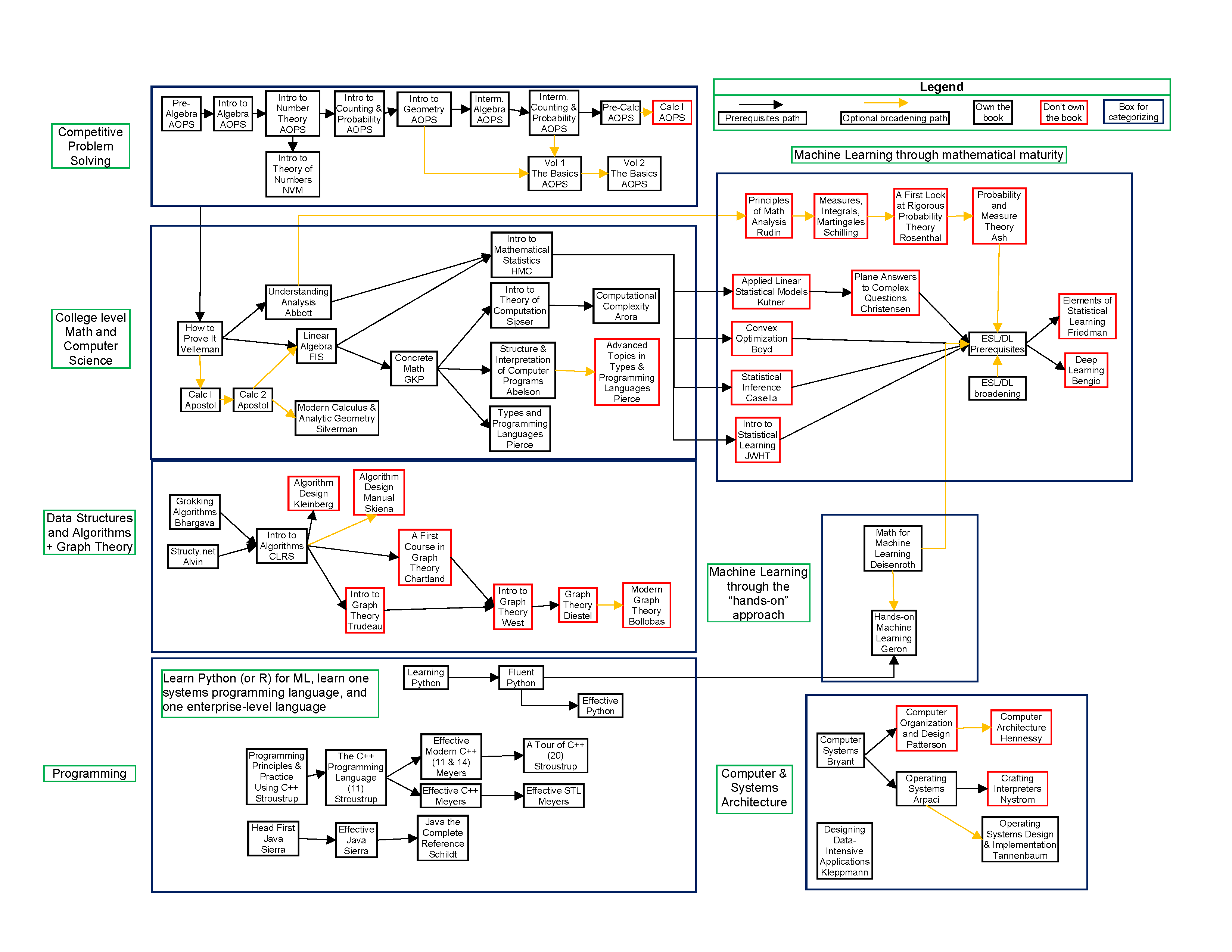
Watch some videos from Michael I. Jordan on what AI/ML is and is not: here for lecture style or here for a podcast.
Terms like Artificial Intelligence, Cybernetics, Machine Learning, and Deep Learning describe an emerging interdisciplinary field that takes years of study and practice to become competent in. People often enter the field from backgrounds in computer science, data science, math, neuroscience, etc. Some folks take the "hands-on" approach while others spend years attaining math maturity.
If you're interested in working in the field, rather than learning enough to use it as a hobby or to solve some of the problems you encounter in your own field, I encourage you to talk to people in the industry, write down your priorities, make a 5- or 10-year plan, and backwards plan everything you need to do to be successful. Your daily actions should feed into your priorities.