The Military Transition Guide I Wish I Had
What to do and when, from eighteen months before ETS to long after it.
Lessons from my own transition, with the documents, links and videos I used. A few sections carry a personal story where it shows why a step matters. Most people in the system do their best inside a bureaucracy that does not serve you by default. You will have to push it. Questions and corrections are welcome.
For a move into a technical job, see Everything I learned transitioning from the Army to Software Development
18 to 24 Months before ETS
18-24 months
The earlier you can complete the Transition Assistance Program (TAP) the better. I recommend completing TAP as early as possible. That's because not having a completed DD Form 2648 will prevent you from being able to schedule a Career Skills Program (CSP) internship.
Retiring soldiers can begin TAP 24 months out from their ETS. Everyone else can begin TAP at 18 months from their prospective ETS date. You start TAP by going to your installation's TAP center, registering for the program, and getting a counselor assigned.
You can find the information for Fort Moore at Fort Moore | Army Transition Assistance Program (TAP).
Check that you have access to your TSP account and that you are getting the Army matching contributions, and move your retirement to a fund you like. The general rule of thumb is if you're young, or don't need access to your retirement, invest it in "riskier" funds like the S fund. If you're older, or more risk-averse, choose "safer" funds.
STORY ABOUT HOW I LEARNED THIS: I began TAP at around the 11-month mark, told my TAP counselor I wanted to do a CSP in Chicago, and then my TAP counselor spread out my appointments all the way out until the 6-month mark. My TAP counselor didn't seem familiar with CSP but said we would discuss at a future appointment. It seemed reasonable at the time since I didn't know any better. At around the 9-month mark, I reached out to my installation's CSP coordinator but she said she wouldn't give me the CSP documents until I was TAP complete. I then had to go back to my TAP counselor and tell her I needed her to re-schedule all of my appointments so that I could be done as quickly as possible. When I completed TAP at about the 8-month mark, I found out that I had to get O6 approval for my CSP in Chicago since it was outside of a 50-mile radius from Fort Moore. Fort Moore also didn't have any CSP options available for my timeline (remote or in-person). I had to personally reach out to countless companies to create a CSP, and then get JAG and Installation Command approval. I even flew out to a job conference in DC to approach a Northrop Grumman recruiter that I'd lost contact with. I got the approval from Northrop Grumman too late for JAG approval and I lost out on my dream CSP. That didn't end up mattering though because my packet had not been sent up to the approval authority by the bureaucracy. But that's another story. I had great Company, Battalion, and Brigade commanders, along with the support of my unit, so everything eventually worked out. You might not, so you will need to advocate for yourself and understand requirements and timelines in-depth.
The most important skill to have is the ability to search for the answer to your questions
Learn how to use google search to find what you need. I like to google to search Reddit and quora for the answers I'm looking for. Just add "Reddit" or "quora" to your search terms, and try to look for the most recent posts with the most discussion. The most upvoted answers are usually the best. The dissenting opinions are also important to understand.
"best ______ Reddit"
"best ______ quora"Reach out to people after you have done your homework
Use content creators on YouTube, TikTok, and Reddit to help your transition. Just use what you're interested in as a search term and they will feed you the people that are related to that topic.
Use Credential Assistance (CA) to pay for relevant education. CA does not incur a service obligation for any soldier, including officers. Updates to Army Credentialing Assistance Policy Paragraph 10a. "The service obligation for the CA program has been removed per reference 1a, dated 13 October 2021."
- Your VA Transition Assistance Program (TAP): An Introduction
This is one of the intro videos they show you. You can go to this website to see an example of some of the classes you will take TAP Online
You need to check that all of your illnesses and injuries are appropriately recorded in your medical record. You also need to follow up with anything that's happened earlier in your career (even if you let it go untreated). If you don't get follow-up treatments for something, later the VA will assume it didn't bother you so therefore it wasn't a problem.
The best way to complete the VA disability process is through the Benefits Delivery at Discharge (BDD) program when you're between 180 and 90 days from your ETS. The benefit of doing a BDD is that it will be substantially easier to get your benefits paid upon ETS. You will upload your medical record (which you will have to request at about the 7-8 month mark), complete a physical, register a VA account, and initiate an online BDD claim.
DO NOT PAY ANYBODY FOR ANY HELP WITH VA DISABILITY SERVICES. THERE ARE A LOT OF SCAM ARTISTS WHO WILL TAKE YOUR MONEY There are so many free resources that can help you. TAP has a good VA disability class, YouTube has some popular disability content creators, and there are plenty of resources online. The VA has dedicated people to help you, veteran organizations like DAV provide free help, and I'm sure you know folks who have gone through the process that can help. Do not do it alone. Do not pay anyone to help.
You need to start thinking about important life-altering questions
- What date do you want to leave the Army? (ETS date)
- What do you want to do after you leave the Army? Do you want to start a different career, pursue education, start your own company, retire etc?
- What are your priorities for your transition? How important is moving to a specific location to you vs getting your dream job vs maximizing total compensation etc?
Here are some books to help you think about what the next stage of your life can look like
Immerse yourself in transition books, videos, and surround yourself with people willing to answer your questions
Here are the most recommended books from West Point's Association of Graduates. I recommend reading them all.
Designing Your Life by Burnett and Evans
What Color is Your Parachute by Richard Bolles, updated annually
So Good They Can’t Ignore You by Cal Newport
Mission Transition by Matt Louis USMA ‘91
Below are some books you can read to help you learn how businesses operate. This is important because you don't want to stand out during your job search. If you want to start your own business this is even more important.
You want to give your future employer the impression that you're an experienced professional that is pivoting to another career.
You don't want to give the impression that you're "starting over" as an entry-level employee. They'll assume you require extensive training, they're unsure if you'll be an asset to their organization, and they don't know if you have professional attributes (being on time, communicating expectations, teamwork etc.)
Read an MBA summary book
Identify companies you want to do an internship at. Here are some popular websites to find internships:
Microsoft Software and Systems Academy
You can find more by googling the company's name plus "SkillBridge" or "military transition."
Some internships are competitive or have specific cohorts. Find ones that meet your timeline. You can also create your own CSP. There are additional requirements to create your own CSP but it'll be worth it. You can see the required documents if you scroll to the CSP portion below or go to the CSP folder of my GitHub.
Recommendations during TAP
- Take it seriously, take notes, and passionately prioritize your transition.
- Do more. Get your resume reviewed iteratively, take nonchargeable leave to job conferences, develop your LinkedIn network, read developmental books, etc.
- Tell your TAP counselor what date you want to be TAP complete so that they can plan accordingly. They have the flexibility, if there's availability, to move your appointments around so that you can be done as soon as possible.
Develop your network as early and as often as possible.
Here is a quote from a mentor on Veterati:
"Most jobs aren't publicly advertised. Most jobs, advertised or not, are filled by networking of some kind: applicants known to current employees, applicants known to someone the employee knows, (and trusts), or recruiters. Few jobs are filled by blindly interviewing random resumes that survived the artificial intelligence (AI)-powered algorithm “keyword” screening."
Understand how to have a productive 20-minute networking meeting or you will waste each other's time.
West Point's Association of Graduates recommends reading "The 20-Minute Networking Meeting" by Perez and Ballinger. There is also an accompanying video in Handshake in USMA's Career Center Resources.
Below are two general transition and networking advice documents.
- Veteran Basics
This document, from a Veterati mentor, provides essential tips and advice for veterans transitioning to civilian careers.
- Networking Tips
Networking tips from USMA's AOG
You need to master LinkedIn before you begin your job search.
You need to know how to effectively find people and opportunities on LinkedIn.
You need to be able to do a precision search on LinkedIn.
I recommend looking at profiles of people that have jobs you're interested in or came from the same background as you.
You can even reach out to them for a networking meeting to answer any questions you have. It's best to develop relationships in advance. You don't want to cold call someone and ask for a referral.
Add/follow people that have jobs you're interested in, their managers, the company page, and the company's HR managers and recruiters.
In some companies, managers do the hiring. In others, HR does the hiring. In some, both have a say in the process.
Recruiters often post job opportunities, networking events, highlight trends, give out excellent advice, etc.
- How to find people, recruiters and hiring managers on LinkedIn
How to search on LinkedIn effectively
- LinkedIn Job Search Checklist
You can find countless resources online on how to develop a great LinkedIn profile
- How to use Boolean search on LinkedIn
You can also take a look at LinkedIn's instructions for boolean search here
Join organizations that will get you in contact with people that want to help you.
They can be veteran-focused charities, educational institutions, minority organizations, professional societies, etc. Use your network to find people that know the answers to your questions. You aren't the first person to do anything. Find someone who has done what you want to do and get their help.
Lookup local events on sites such as Meetup.com or Eventbrite.com.
Get a mentor.
American Corporate Partners pairs transitioning service members, veterans and active-duty spouses with a mentor from a company for a year, for free.
12 to 18 Months before ETS
12-18 months
Once you are TAP complete, you will get a signed DD Form 2648 and you can use that to contact the Career Skills Program Installation Administrator (IA) and ask for the requirements to do a CSP.
Successfully completing a CSP at a company often results in a job offer from the company.
At a minimum, they have to give you an interview. Most of the time, they only accept people they are interested in hiring. The benefit for them is they got a cost-free employee that they got to try out for months. You will be a known quantity, they'll have built a relationship with you, you'll have already had months of relevant experience doing that specific job, etc.
They will send you an email similar to the message and documents below.
Key highlights and recommendations
- The approval authority for CSPs within a 50-mile radius of your installation is the first field grade in your chain with command authority, which is usually your Battalion Commander. The approval authority for CSPs outside of a 50-mile radius and lasting 60 or fewer days is an O6 commander (can be delegated to O5). The approval authority for CSPs outside of a 50-mile radius, and between 61 and 180 days, is the first commanding general in your chain of command (can be delegated down to an O6 commander). I heard a rumor that the MCOE CG is now the approval authority for Fort Moore CSPs outside of 50 miles and longer than 60 days. I used 1st SFAB's O6 commander for my CSP approval.
- You aren't limited to the CSPs offered by your installation. You can do any internship in the DOD SkillBridge network. You can also make your own internships if none of the offered options fit your needs and desires. Check below, or see the CSP folder on my GitHub, to see what documents you need for that. In general, you need to find a company that will work with you, create a training plan, and get JAG and INSCOM approval. Make sure you give JAG about 30 days to review and approve your CSP.
- Your CSP, and any terminal leave you decide to take, need to start and end within the 180-day window between your ETS. For example, you can do 180 days of a CSP but you'll have 0 days of terminal leave (so you'll have to take your "ordinary" leave before the CSP). You can do 120 days of CSP and 60 days of terminal leave, which will equal 180 days together. You can take leave before the 180-day window but you can't mark the DA 31 as transition leave. It needs to be marked as annual (ordinary) leave. If you decide to take leave before the 180 days before CSP, do not call it terminal leave to your S1 or leadership, that will only cause confusion. I recommend that you leave 10 business days before your terminal leave date so that you can come back and clear the installation.
- You can sell extra leave days back to the Army but they will be taxed at the marginal tax rate of ~22-25% and you won't get BAH for it.
- If you want to maximize the amount of money you get, use your earned leave before and/or after your CSP.
- Reach out and apply to companies early. You need their signature for your CSP packet.
You can get access to LinkedIn premium for 12 months as a veteran. I'd recommend activating it when you feel comfortable navigating LinkedIn and you are ready to grow your network.
The main benefit I saw from premium was being able to send messages to people outside your network. I didn't care about seeing who was looking at my profile. I don't see the value of LinkedIn Premium once you've built your network. So, I'm not going to pay for it once it expires.
[Example message from CSP administrator]
Hello,
Thank you for your interest in the CSP Individual Internship. Please review the eligibility criteria below and the instructions for submitting the documents.
- Requires Soldier to be 6 months/180 days of ETS or retirement date [not inclusive of the terminal leave time].
- CSP participation may only involve ONE company or training program within the 180 days not to exceed 120 days.
- Establish POC with the company, internship start/end dates, and a weekly internship curriculum.
- Requires Command approval and signatures on submission of all documents required.
- Completion of TAP [include the Form 2648 with packet received at completion].
- Requires submission of the Internship packet 1 month before your planned start date [for Legal and Regional Coordinator approval process, at this time Legal is taking 15-30 days to process packets].
- An approved Administrative Absence signed by the O-6 must be acquired to participate outside 50 miles of Fort Moore.
- Be mindful that CSP must begin after or be complete before transition/terminal leave if you plan to take it during the 6-month window of CSP participation.
INSTRUCTIONS FOR COMPLETING INTERNSHIP DOCUMENTS:
- CSP Individual Internship Agreement: Complete and submit in the same fillable format originally provided with digital signatures. (Do not print or scan this document. Return in the editable digital PDF format with digital signatures.)
- CSP Participation Memo: Complete and submit in the fillable format provided with digital signatures. Must have O-6 approval for Administrative Absence.
- DA31: Complete with O-6 signature only if the internship is 50 miles outside of Fort Moore.
- CSP Commander's Checklist: Complete with both your and Commander's initials. Please select "No" if any of the questions do not apply.
- Please include the TAP Form 2648 provided by your counselor.
- Please attach a separate training curriculum including each week you will be interning (See example attached).
- Please check that the dates on the start and end dates DA31 and Participation Memo are the same.
- Please include in the Internship Agreement, outcome section, there will be an interview opportunity. Please label and attach each document individually. Do not submit the packet as one scanned PDF document.
Please state in #4 of the agreement that the internship will lead to an interview with the company. Follow all instructions provided to prevent delays with the final approval process. If you have any questions or concerns, please do not hesitate to contact me.
Warm Regards,
XXXXX
Career Skills Program Installation Administrator (IA)
Soldier for Life TAP Bldg 9230
8150 Marne Rd. Fort Moore, GA 31905
P: XXXX
E: XXXXX
- Example Letter for PEBLO
This document is only required if you're going through a "med board" and want to do a CSP.
This is important because administratively there will be long wait times without any notice if you're being kicked out or not. You can use this time to do a CSP instead of languishing in uncertainty. When they do decide to med-board you or not, all of a sudden they might tell you you've been med-boarded, they'll send you a VA and DOD compensation offer to negotiate, and you'll have about 30-60 days or less to get your affairs together and out-process the Army.
STORY ABOUT HOW I LEARNED THIS:
My friend and I worked together in the same unit, started separation processes at around the same time, and ETS'ed at around the same time. I UQR/REFRAD'ed while he went through a med board.
He went from languishing for months not knowing if he was able to stay in the Army, to being told he needed to quickly get out. He didn't do a CSP, since none that Fort Moore CSP offered fit his timeline or needs. He also didn't feel he had enough time to make a CSP with another company. And on top of that, he stayed at our unit working which messed with his ability to focus on his transition.
Meanwhile, I spent my time doing an internship, interviewing at companies, and got dedicated time to work on my transition.
- Internship Training Plan
Here is an example training plan for creating your own CSP with a company. Some companies already have their own training plan if they have already hosted CSP interns. This is much more thorough than required. My CSP coordinator ended up only submitting the first sheet. That makes me think that's all that would be required for approval.
If you are interested in education, you should apply to universities and scholarships at this time. You should apply to schools outside of what you "think" you can't get into. Top schools like Harvard, Yale, University of Chicago want veteran representation and it'll be easier for you to get in as a veteran. You will still have to put in a lot of work to "sell yourself" but it will be worth it.
You can use the Yellow Ribbon program, the Pat Tilman scholarship, and several other resources to cover additional expenses. Learn how the GI Bill works. The TAP gives a great GI Bill course and teaches you tools like the VA comparison tool.
If you are interested in working, be aware of VA education and job training programs like VET TEC.
TAP has a great course on helping you understand what career fields have great opportunities, and what locations have better opportunities for your chosen career field.
You should decide if you are restricted by location.
If you're not, where are you interested in living? Are you willing to relocate for a job? If you are, what is the minimum compensation package that makes moving worth it to you?
Learn the art and science of resumes.
Develop a couple of versions of your resume. The most important part is doing a brainstorming exercise where you write down every result you've produced in your career. You can use old OERs and counseling to help you start. This will help you translate your Army experiences to civilian terminology. Use the Project, Action, Result model.
You can use the brainstorming exercise to tailor your resume to highlight experiences that match the job description.
- General Resume Guidelines
General resume guidelines
- Booth Resume Template
Resume template
- Resume Writing Guide
Resume template
- Resume Formatting 101 Updated
More resume advice
- Action Verbs
More resume advice
- Resume Accomplishments or Bullets Builder
Structuring accomplishments
- Resume Fix List
Structuring accomplishments
UQR/REFRAD personnel need to produce the following documents:
- UQR/REFRAD request to HRC.
- BDE CDR counseling signed by your CDR and addressed to HRC. This requires you to draft the document and then schedule a counseling by your BDE CDR (so they can sign it).
- Get a counseling signed by your installation's Reserve counselor.
- A memo stating that you aren't resigning due to SHARP.
Do not let your company commander, battalion commander, or S1 try to deter you from submitting your UQR/REFRAD. They are not the approval authority.
STORY ABOUT HOW I LEARNED THIS:
I had incredible Company, Battalion, and Brigade commanders at my last unit in the Army. I scheduled my BDE CDR counseling at about 13 months until ETS. I had an awesome Battalion Commander who asked me to cancel it so that he could work to try to find a BN in Chicago that could take me in a recruiting or ROTC role. We exhausted those options while I got sent to Airborne school at the 11-month mark and I couldn't do anything about my UQR/REFRAD.
It then took an additional couple of weeks to schedule a counseling session and get my BDE CDR to sign it. Once I submitted my UQR/REFRAD at about the 9-10 month mark, it waited at HRC. I later found out from my lawyer that the reviewer/approver was on leave. The unintended consequence of listening to my Battalion Commander cost my UQR/REFRAD to be delayed by 3 or so months and could have easily derailed the rest of my transition if my lawyer hadn't made sure the reviewer/approver prioritized it when he got back.
9 to 12 Months before ETS
9-12 months
Retirement & UQR/REFRAD packets can be sent up through your chain of command at 12 months until ETS.
You need to get the contact information for the relevant section at your installation's G1. BN or BDE S1s will send your packet to G1, and it is on G1 to send the packet to HRC. S1s usually do this by sending your packet to a group G1 email. G1 can be picky and unresponsive, so you need to follow up with them. They've been known not to respond if something isn't done correctly.
At Fort Moore, the G1 equivalent for the installation is called the Directorate of Human Resources and they are at building 35. The information they put out will likely not make it down to you due to personnel turnover and the "telephone game" that happens during info distribution through the chain of command. Requirements, and the people in charge, change, so you will need to know what every echelon in your chain of command requires all the way up to HRC. It's daunting but worth it.
The Army needs an electronic administrative action processing and approval system. S1s are overwhelmed with administrative tasks and don't have good systems to track and process them. On top of that, S1s in SFAB don't have clerks to help them out. Email is not a good method for processing and tracking administrative actions. People change duty positions at every level, and requirements change all the time. S1s are good people stuck in a bad system.
STORY ABOUT HOW I LEARNED THIS:
My S1 said he sent my request for orders at around the 8-month mark. He would respond with something to the effect of "it's pending approval at G1" when I asked for a progress update. At the 6-month mark before ETS, when it was getting close for me to move to Chicago for my CSP, he told my 1SG that I had never sent my request for orders to him. I sent him an email confronting him about what I perceived as lying and telling him that I was going to escalate the situation if I didn't get help with my CSP, orders, and Reserve transition.
I went to building 35, found the permanent party separation department, and found out that my request for orders, whether it was sent or not, would not get approved because for the first time in 2 years, since before COVID, they were now requiring in-person ETS briefs before soldiers can request orders. The civilians also said that they had repeatedly pushed this information out to the S1 channel. Every week at every Army installation there are people suffering transition nightmares. The Army will then pay the price for these nightmares financially via unemployment, or the Army's reputation will suffer when stories of these transition nightmares are spread. I personally witnessed three examples on my Final Out day when I cleared Fort Moore on 30 September. I also faced a lot of bureaucratic heartaches and had to fight hard to get what I needed.
- There are people unable to retire on their original timeline because they didn't attend a mandatory retirement brief (that they did not know about).
- Leaders escorting people to clear installation a month after their ETS date. Their units didn't prioritize the soldier's transition, and the soldier didn't fight them back hard enough. The person that pays the price in these scenarios is the soldier. Their transition timeline is messed up and they are clearing without getting paid.
- People trying to final out with just a unit clearance record (there are so many more requirements than that).
I asked the civilian who issued my DD214 how often horror stories like that happen. She said they happen every week and that the information G1 distributes does not make it down through the S1 channels to the soldiers.
You need to be proactive, keep receipts of all interactions, and be willing to escalate to a higher authority if you don't get the help you need in an acceptable timeframe.
You have the S1 chain, the leadership chain, speaking to civilian supervisors, ICE complaints, your congressperson, or you can consult a lawyer. The longer you wait, the less time you give yourself and others to fix your problem before you have to use a "nuclear" option like a senior-level commander or a lawyer.
The system is bureaucratic and it's easy for your administrative actions to fail to make it through. It's worth fighting for. Do not feel awkward or ashamed about advocating for yourself.
"the squeaky wheel gets the grease"
"hungry mouths don't get fed"
Submit your signed and completed CSP packet to your installation coordinator several months before your CSP start date.
It might take JAG up to 4-8 weeks to review/sign your packet and send it to the installation command.
Your CSP coordinator will inform you when your CSP has been approved.
Do not take no for an answer if your CSP, retirement/UQR, or other transition documents get "disapproved."
Keep escalating it. Your transition is worth fighting for.
You’re your own best advocate. Your more senior commanders probably don’t even know about your denial, and likely won't support the denial. “People first” isn’t just a saying. Soldiers transitioning well is in the best financial and political interests of the Army, on top of the morally right thing to do.
Do not let anyone other than the approval authority stop your packet from reaching the approval authority.
The lowest approval authority for a regular CSP is a field grade officer which is usually a BN CDR. An O3 is not the approval authority for any CSP. If the CSP is >60 days, then the approval authority is the CG or an O6 that has delegation authority. Get justifications for disapprovals in writing.
If they do support the denial, your best solution is to fight so hard for your CSP that it makes approving your CSP the path of least resistance for them.
STORY ABOUT HOW I LEARNED THIS:
I had to cause a ruckus to get my transition, CSP, and Reserve follow-on schools requests processed. My Company Commander was incredible, but he forgot to send my CSP or transition packets up, which cost me a couple of weeks. He was an incredible leader, though, so he apologized and rectified the situation. But then, my BN S1 didn't send up my CSP or transition documents to the approval authority after multiple reminders.
With a week to go until I was supposed to move out of my apartment and leave for Chicago for my CSP, I had no orders, no approved CSP, and no idea if I could get a job after ETS or if I had follow-on Reserve schools. The straw that broke the camel's back was when my S1 asked me to forge the O6 signature on my CSP (which was going to JAG for approval by a lawyer and then installation command). I asked my BN CDR to sign my CSP directly but didn’t get anything back after a couple of weeks.
With one email to the CG about my problems with my transition to the Reserve, and a call from my lawyer to the BDE JAG about my CSP, I got my packets approved all the way to installation command and back in a couple of days. I had politely been fighting fruitlessly on my own for so long. It takes personal courage to advocate for yourself after being a team player for so long.
My perception at the time was that I gave the Army almost 12 years of my life, between the NG/USMA/RA, but my unit butchered my transition and then tried a bit of retaliation when I got help. My BN XO called me, and among other things, threatened retaliation. I documented and reported the retaliation to my lawyer and BN CDR. It was all worth the fighting though.
I completed an incredible CSP, I got to move in with my wife in Chicago after six years of a long-distance relationship, I have a VET TEC software engineer bootcamp lined up, and I am executing a transition plan I am proud of.
"Closed mouths don’t get fed"
"The squeaky wheel gets the grease"
You earned these benefits, now go get them.
If your CSP packet gets mismanaged, you might find yourself in a position where your DA 31, authorizing administrative absence from your unit, has been approved but your CSP packet, authorizing you to work as an intern, is disapproved or missing.
You can get free legal service at your installation's Trial Defense Service (where the defense counsels hang out at your installation). You can also consult your BDE JAG, but realize that they work for your BDE CDR, so that's equivalent to asking a prosecutor for legal help.
STORY ABOUT HOW I LEARNED THIS:
I found myself in the position described above. My CSP DA 31 was signed and approved, but the rest of my CSP packet was still stuck in the bureaucracy a week or so out from leaving. I told my CO leadership and BN S1 that I was planning to leave anyway since it wasn't my fault they fumbled my transition. But, I asked my lawyer to help me with that situation, since I was legally authorized to leave but not legally authorized to do an internship.
It seemed that my unit was okay with letting me be gone, even if the rest of my packet was not approved. What they didn't seem to like was how much I was embarrassing them by reaching out to the CG and BDE JAG about the unit messing up my transition paperwork. I was worried that if something went wrong, my unit could throw the book at me for being AWOL and pretend like it was my fault.
I did end up getting my CSP approved last minute, but my unit would have let me be gone either way since I already had a signed DA 31.
6 to 9 Months before ETS
6-9 months
Submit a request for your medical records at about the 7-8 month mark.
This is usually done at medical records at the installation hospital. It may take 4-8 weeks for them to process your request. This is especially true for the busy summer move cycle.
You should have an idea of prospective jobs and/or companies by this point. Start targeting specific companies and job titles to build a network where you want to land.
You can use Edge/Chrome add-ons like Hunter to get the contact info for leaders on a company's webpage.
Get a joint email/calendar manager like Microsoft Outlook, Google Calendar + Gmail, or a meeting manager like Calendly . Synch your accounts with video conferencing sites like Zoom. for virtual meetings.
Schedule to turn in your CIF equipment before leaving for CSP.
Usually, CIF will require an early turn-in memo signed by your commander to do this (they usually keep example memos on site). If you are missing anything during your first turn-in, you can find the item at a local surplus store and then do a second turn-in when you get your installation clearing papers.
If it makes financial sense, you can make coordinations to move before your CSP. You need to move on or after the publication date on your orders or transportation might not pay for your move.
You can use the Servicemembers Civil Relief Act to break leases. It is customary, but not a requirement, to give a 30-day notice. Here is an example template.
90 to 180 days before ETS
90-180 days
Submit a request for your medical records at about the 7-8 month mark.
This is usually done at medical records at the installation hospital. It may take 4-8 weeks for them to process your request. This is especially true for the busy summer move cycle.
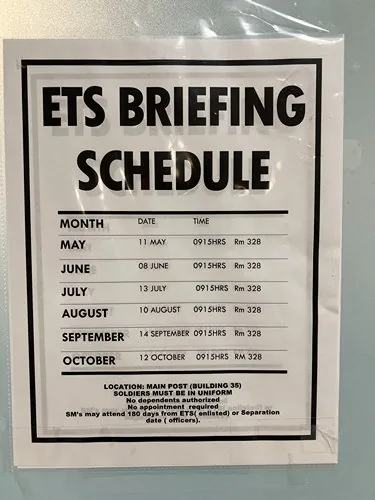
Attend your installation's ETS brief, if it is a requirement by your higher headquarters' G1, as soon as possible.
Sometimes these are done online, and sometimes they are done in person. Once complete, you can send a request for orders packet with your ETS briefing certificate to G1 through your BN S1. It will take G1 about 2 weeks to produce orders for you.
At Fort Moore, you fall under the DHR, so look at the box to get info on speaking to G1.
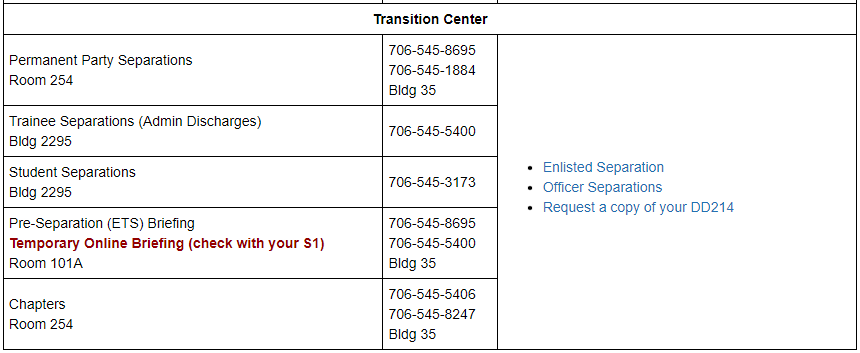
Reach out to your G1 separations sections to get the most up-to-date information on separation requirements. For Fort Moore, you can find their contact info here.
STORY ABOUT HOW I LEARNED THIS:
I was "waiting" for my orders for months without any believable updates from S1. I went to my unit's G1, DHR at Fort Moore, and I found out that my packet was never submitted correctly by my BN S1 so they weren't going to process it. That's because they started requiring in-person ETS briefs THAT MONTH, after a two-year break due to COVID, and I wouldn't get my orders unless I attended their brief and received a certificate to put in my request for orders packet. This info had not been communicated down to the soldier level by BN S1s. I had to drive 4 hours from a field training exercise to do the ETS brief at Fort Moore, and then drive another 4 hours back to the field training exercise.
Identify any vocational training you're interested in and apply for acceptance in the program. Remember, you need to apply for VA benefits AND apply for acceptance from the company.
For VET TEC, find which company offers what you’re interested in, complete the train-up programs, then apply for acceptance.
These are the preferred VET TEC training providers.
Look at the benefits of an in-person course vs remote. You will get less BAH for remote vs in-person attendance. Let your social network know you'll be unavailable during the BootCamp. To start the program, you need to be on terminal leave, DOD Skillbridge, or have ETSed.
Apply for the VA's BDD.
Upload your medical record to your claim when you get it.
Buy a computer if you don't have one yet.
You'll need it to access VA resources, network, work from home, etc. There are many resources out there on desktop vs laptop and PC vs mac.
A desktop has more computing power. You can save even more money by building your own desktop. A laptop has less computing power, and is usually more expensive per unit of computing power, but is more portable. I recommend Apple MacBooks, especially a MacBook Pro, if you want a laptop. Stay away from MacBook Airs if you have any plans to use it for more than typical web browsing and streaming. MacBooks are more expensive than PC laptops but include better integration with cell phones, a more secure environment, and are a requirement if you want to do software development.
You can also start building a home office. This is especially important if you want to pursue a work-from-home or remote position.
If you plan to do a VET TEC here are the usual computer requirements:
Hack Reactor's computer requirements from their FAQ:
Our curriculum, like the rest of the software engineering industry, is heavily dependent on open-source software, which traditionally has not worked well on Windows platforms. For that reason, a computer running macOS or Linux is greatly preferred. Windows users are required to either switch to a Mac or Linux computer (preferred), or install Windows Subsystem for Linux 2 (WSL2). Windows users should expect to spend extra time setting up WSL, installing an Ubuntu dual boot configuration, and/or running Linux via a virtual machine (via Virtual Box). The minimum specs below may not be suitable for running a virtual machine.
You should not use a computer that is actively shared with another person (especially with another software developer) since you will be making system-level configuration changes, and possibly deleting information that will affect those users.
Macs with Apple Silicon M1 are permitted in the immersive.
Processor: Intel Dual-Core i5 or equivalent (minimum)
Memory: 8 GB RAM (minimum), 16 GB RAM (recommended)
Storage: 50 GB available space (minimum)
Peripherals: Working Webcam
Operating System:
- Recommended: Mac OS X (v10.14 minimum, LTS recommended)
- Acceptable: Windows 10 compatible with WSL 2- We do not provide full instructional support for Windows users. Our staff can assist with WSL2/Ubuntu-related issues but may be unable to troubleshoot Windows-specific issues.
- Acceptable Alternative: Ubuntu Linux (LTS minimum)
Zoom and other communication apps, webcams, and microphones may be buggy on Ubuntu. This is outside of the control of staff as they cannot support debugging these issues.
Look up job conferences to attend in the upcoming months. Don't forget that you can go to professional conventions or company-hosted conventions to network and find employment (e.g., DEFCON, Blue Team CON).
If you're interested in the Reserve/Guard, make sure to explore available MOS, benefits, bonuses, and locations you're interested in. The reserve career counselors can send you a list to look through. You can also find the list of open positions on milsuite in the S1 Net.


30 to 90 days before ETS
30-90 days
If you're an Army Reservist then you should submit a PAR on IPPS-A for separation orders at least 90 days out. If you've met your contractual obligation, but still have an IRR obligation, look at the USAR PAG for T-1-E-2. You should also turn-in your equipment to a Supply soldier, maintain a copy of your turn-in, and submit RSTs for any Battle Assemblies you want to be excused from ~45 days in advance. You have an obligation to attend training unless you have orders or an RST.
If you're Active Duty submit your request for orders through your BN S1 who will then send it up to get processed by your higher headquarters' G1 equivalent. At Fort Moore, you can request your orders 90 days out from your terminal leave or ETS date. You can also request your orders earlier for extenuating circumstances. Your orders are one of the key documents that will prevent you from moving forward with clearing and moving.
STORY ABOUT HOW I LEARNED THIS:
I was paying for my apartment outside of Fort Moore AND my wife's apartment in Chicago while she was in residency. It made financial sense to move to Chicago during my CSP so I requested my orders early. I had already briefed this as part of my transition plan to my leadership. Transportation may not pay you if you move before the publication date on your orders. My orders had a publication date before I moved to Chicago so I was able to get paid for the move.
You should begin applying to jobs, even if that is not your goal or you already have something lined up. You will gain valuable experience during interviews. Ask for feedback after an interview. Do an AAR with someone you know after every interview.
You can use sites like Glassdoor and Blind to get inside info on things like the culture of a company, or what to expect for compensation.
You should also begin interviewing for jobs at this time. Most companies don't want to entertain prospective applicants until they're 30-90 days out from their availability date.
If you haven't already, apply for the GI Bill and VET TEC.
It takes about 30 days to approve and receive your Certificate of Eligibility (COE), so it's better to have it and not need it than to need it and not have it.
STORY ABOUT HOW I LEARNED THIS:
I found out about this too late. I missed out on being able to do VET TEC while I was on terminal leave because I received the VA COE the weekend after the course deadline for registration. That cost me about a two-month delay in finding employment.
If you chose to do VET TEC, find which company offers what you’re interested in, complete the train-up, and take the entrance exam. It could take you 2 months to do the train-up and multiple attempts to pass the assessment, so plan accordingly.
Look at all the different pros and cons of the companies.
Going remote will give you less BAH than in person. But, going remote will allow you to be anywhere you want to be.
If you haven't moved yet, 60-90 days out is the minimum amount of time you need to start planning for your move. Schedule a transportation brief. Here are some things to think about.
You can use the Servicemembers Civil Relief Act to break leases.
Apply for BreakLine . If you're doing a bootcamp then apply after you graduate from the bootcamp. Breakline is probably the best way to break into a tech company, even if you don’t have a tech background. It's an incredible program and they teach you interview/resume skills and introduce you to tech companies. Their mission is to get veterans, minorities, and women into high-paying jobs at tech companies.
10 to 30 days before ETS
30-90 days
If you're a Reservist then check on the status of your ETS PAR. Submit RSTs in case your orders are delayed. If you're Active Duty, at 30 days out apply for your installation clearance papers through your BN S1.
Fort Moore G1 won't process installation clearance paper requests until you've completed CSP.
0 to 10 days before ETS
0-10 days
Upload your Personally Procured Move (PPM) to DPS and submit your move packets to transportation.
You can do this in person or via mail. Submit per diem request to finance. The instructions are on the packets you get when you clear those offices.
You can calculate how much to expect from your PPM using calculators like the one next to this tile. You will get 95% of the cost to the government to pay professionals to move you. The Army will pay you what it'd cost to get you from your current duty station to your home of record at entry or the location you entered service.
You need to get empty-weight and full-weight tickets to get paid for your move. They'll give you the finer details in your transportation brief. For example, do not include your personally owned vehicle as part of the net difference in weight. Do not try to defraud the system. If you weigh it, then you must move it.
Clear your installation and out-process the Army. If you haven't done it already, you need to do your separation physical during this period. If it's been more than 30 days since your Phase 1 physical, you will need to go into your MEDPROS and add an update to your medical status as per the instructions on your SHPE packet.
Go to medpros, click on "periodic health assessments," go to the "SHPE" tab, and fill out a medical update (DD Form 2807-1).
Make sure your final pay sheet at finance is accurate before you sign. For example, make sure that you're selling the number of leave days you want.
Don't forget that you'll need lodging and transportation if you've already moved away from your installation. Costco provides a rental car discount. You can save money by staying with a friend or even staying in your car.
Terminal leave
Terminal leave and ETS
Review your DD214 for accuracy.
Make sure your ETS address is correct. Bring copies of awards, school records, and an SRB/ORB. Correct everything on the spot and do not leave until it is correct. The civilians are generally helpful. There are benefits tied to how long you served, the character of your service, and what you did while you were in. If you claim you did something, and it isn't on the DD214, then that's tough luck for you.
If you leave, and your DD214 requires corrections, you will have to go through HRC to make corrections, and it will be much more painful.
Store your DD214, and all other important documents, in a safe location.
Optimally, in a fire and water-resistant place. Make digital copies and email them to yourself.
Upload your DD214 to the VA. It will go in as a supporting document to your VA claim.
0 to 30 days after ETS
0-30 days post ETS
Your last Army paycheck will be delayed about 2-3 weeks from its usual payday.
If you signed up for Reserves/Guard, make sure to do the following:
Sign into your unit within 30 days of your ETS, get a new CAC from a DEERS office near you, and sign up for Tricare Reserve Select. You have to do it in that order according to the Fort Moore Reserve officer counselor.
Once you "hit" your Army Reserve unit's books, inprocess and request a pay action and an Army Reserve DFAS account. Once you have your pay setup through the USAR it'll show up in a dropdown menu on myPay.
You have transitional healthcare programs for about 180 days after ETS. The personnel at the ETS brief said you need to apply for these immediately after ETS. However, the website makes it seem like it is applied automatically. It happened "automatically" for me and I was able to verify it on milconnect. Do your own research and make sure you have coverage before you need it.
Retirees and Reserve/Guard have different healthcare benefits.
You need to send your PPM and per diem voucher back to your installation transportation office.
These are two separate payments you'll receive. I put it off for about 5 months, but you have up to a year past your ETS date. I got paid around $5k for PPM and about $500 for per diem.
Long after ETS
Long after you ETS
Your first post-transition job might not be what you wanted, or how you thought it was going to be. It's okay to job-hop.
Companies generally are more likely to pay higher compensation packages to new hires than they are to give internal employees raises. Therefore, job hopping is the easiest way to get a substantial raise.
If you can't meet the initial requirements to get hired into a company for your target job, it is likely easier to transfer to that role as an internal employee. For example, getting a software engineer role as an outside hire at Amazon is rigorous, but moving to another team as an employee is easier.
Attend conferences for your chosen profession.
These are great places to network and learn about industry trends.
You have benefits that last long after you ETS.
You learn about them during TAP. For example, you can use VET TEC a second time if you need help transitioning to another job again as long as it's 18 months between courses.

Get help from a VA accredited representative or VSO | Veterans Affairs
An accredited attorney, claims agent, or Veterans Service Organization (VSO) representative can help you file a claim or request a decision review. Learn how to find and appoint one of these types of accredited representatives to help you.
www.va.gov
You may need to fight for benefits. Put up a fight to get the benefits you deserve. The VA is a bureaucratic system, but you have government and non-governmental support. You can reach out to organizations like DAV for help while working on your disability claim with the VA.
If you lose your DD214, you can request a copy from here.
Give back to veterans.
You got a lot of help along the way. Do what you can to give back.